
Condemned to Cooperate
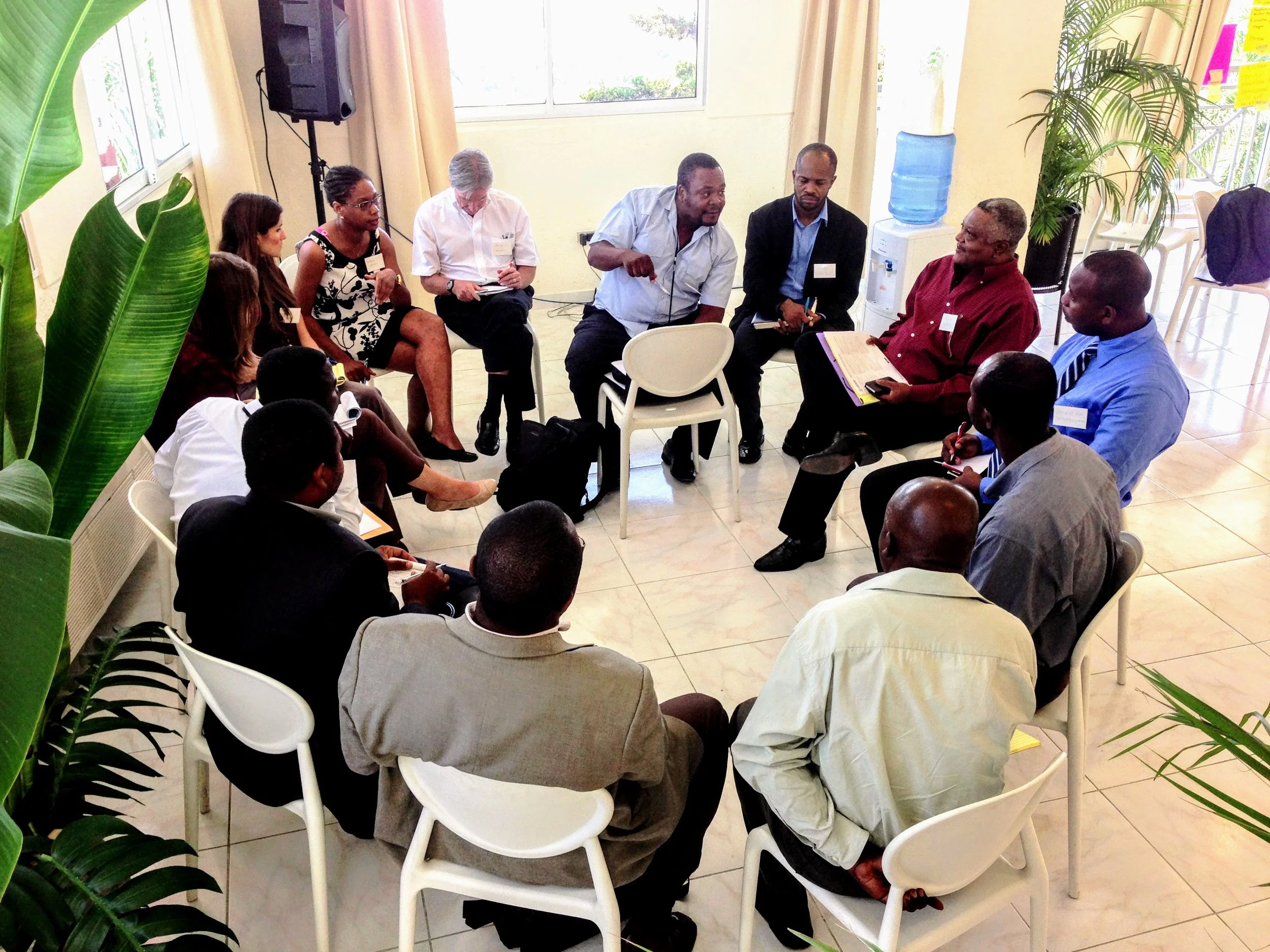
One of several breakout sessions of cooperative leaders during an Open Space meeting at Hotel Montanna, Port-au-Prince, Haiti 2013
It was 9:30 a.m. on Thursday, September 26, 2013. About sixty of us were seated in a circle in a conference room at the Hotel Montana complex in Port-au-Prince. It was one of the conference rooms built after the main hotel was destroyed in Haiti’s 2010 earthquake. Most were Haitian men, though a number of women were present as well.
The setting carried its own symbolism. Long associated with power and exclusivity, the Hotel Montana was now hosting a gathering designed to be open, participatory, and shared.
I had carefully prepared the room following Open Space practice. Large sheets of paper were posted on the walls, handwritten in Haitian Creole. They held the simple, demanding principles that guide this kind of work:
Whoever comes are the right people.
Whenever it starts is the right time.
Whatever happens is the only thing that could have happened.
When it’s over, it’s over.
Nearby were reminders of the Law of Two Feet, also known as the Law of Mobility, along with the phrase Passion bound by Responsibility. I had drawn, by hand, the image Open Space facilitators use to illustrate it: a butterfly and a bumblebee. Both move freely, guided by energy and purpose, neither obligated to remain where learning or contribution has ceased.
The circle itself was intentional. No podium. No hierarchy. No expert at the front of the room. Just people seated together, carrying experience, frustration, hope, and responsibility. Leaders of cooperatives from across Haiti had gathered to speak openly about their work and to learn from one another.
When it was time to begin, I handed the microphone to Saint Fort Dadaille, the representative of the Haitian government agency responsible for cooperatives. Poised and elderly, dressed in a suit, he walked into the center of the circle, looked slowly around the room, and paused.
“We are grateful that you have all come from around the country for this important gathering,” he began, speaking in Haitian Creole.
He explained that the day would be spent discussing the progress and challenges facing cooperatives in Haiti. Participants would propose topics themselves. Small groups would form. Notes would be taken and shared as part of a participatory evaluation.
Then he paused again.
“I want to begin with words that have been my mantra for decades,” he said. “We are condemned to cooperate.”
Nou kondane pou kowòpere.
He let the phrase hang in the air.
“With Haiti’s many challenges,” he continued, “we do not have a choice. If we wish to advance ourselves, we cannot work in isolation.”
He spoke of Haiti’s geography. Its history of brutality and exclusion. Environmental degradation, discrimination, and the barriers created by language and law. And then he returned to his central point.
“With all of this,” he said, “we do not have a choice.”
“We are condemned to cooperate.”
This was one of hundreds of Open Space meetings I facilitated over several decades in Haiti. As the day unfolded, participants proposed topics they felt mattered most, self-organized into small groups, and reported back with clarity and conviction.
As I write these words now, Haiti’s situation has grown increasingly precarious. The country faces a convergence of internal and external threats, and the future is deeply uncertain.
Yet while Haiti’s circumstances are unique, I have come to believe they also reflect something broader.
Haiti is not only a nation in crisis.
It is a mirror.
It reflects a world facing environmental collapse, political fragmentation, widening inequality, and a growing inability—or unwillingness—to cooperate across difference. Humanity, too, stands at a crossroads.
The statement is serious, even sobering.
And yet, if Haiti has taught me anything, it is this: collective work is often accompanied by joy. By laughter. By relationship.
Cooperation is not only a burden we must carry. It can also be a way of being human together.
Still, the truth remains as clear now as it was that day in Port-au-Prince.
We do not have a choice.
We are condemned to cooperate.
And that is why our moment is now.