
Blog
Study Culture
The Invisible Force Shaping Behavior, Meaning, and Our Capacity to Adapt
Allain reached for a small tree branch and stripped off the leaves with practiced ease. He grinned as he handed it to his six-year-old twin sons.
“If there is going to be education,” he said, “there has to be punishment.”
Jude and Nichola giggled with delight. The idea of children correcting the Haitian Creole of an adult white man with a whip was more than silly. They recognized the gesture. In schools throughout Haiti, branches, belts, and paddles were commonly used to punish misbehavior and even wrong answers. But them whipping me? The reversal made it funny.
Allain wasn’t being cruel. His humor exposed the strangeness of applying what was normal in school to this moment, an adult learning from children.
In that moment, I learned a lesson I would spend years trying to understand: culture teaches long before we ask questions, and often long before we notice the lessons being passed on.
With my limited Haitian Creole, I had asked my new neighbors, Allain and his sons, if they would help me learn their language. I told the boys, “You’re children, but you communicate well in Haitian-Creole. You could be among my teachers, if you’re willing.”
I believed learning would happen through patience, encouragement, and correction. Allain assumed learning required discipline enforced through pain. Neither of us was improvising. We were each drawing from a cultural script we had inherited.
Culture is more than decoration or folklore. It is an invisible force shaping behavior, meaning, and our capacity to adapt. It governs how authority is exercised, how mistakes are handled, what is rewarded, and what is feared. It trains us not just in what to do, but in what makes sense.
When I moved to Haiti, I learned Haitian-Creole by living with a non-English-speaking family. I swept and hand-mopped floors, bathed with a bucket, accompanied neighbors to the market, and learned to speak the way children do, through repetition, laughter, embarrassment, and grace. My usefulness depended not on vocabulary alone, but on understanding how people made meaning of their world.
That learning was often humbling. Sometimes unsettling.
Allain’s comment about the whip was one of those moments.
Traditional education in Haiti has long emphasized memorization, recitation, and obedience. This did not emerge in a vacuum. Systems of authority and schooling were shaped by centuries of colonization, enslavement, and domination, followed by outside interference long after independence. Education was designed less to cultivate agency than to produce compliance.
Brazilian educator Paulo Freire gave language to what I was witnessing in Pedagogy of the Oppressed: education is never neutral. It either trains people to adapt to existing systems or equips them to question and transform them.
Culture determines which of those paths feels normal. A culture shaped by authoritarian conditions tends to produce an educational system that trains people to comply. At least until there’s a rebellion. A culture rooted in shared civic responsibility tends to produce an education that equips people to think independently. Finland is often cited among countries with strong public education systems that foster independent thinking. Canada, South Korea, Singapore, and the Nordic countries also score high.
A healthy culture is not one that resists change, nor one that embraces every innovation uncritically. It is one that discerns. It judges what aligns with its values, what undermines them, and how new realities can be integrated in ways that serve life now and into the future.
When that capacity weakens, behavior continues unchanged even as conditions shift. What once made sense begins to cause harm. The problem is not intelligence or effort, but a diminished cultural capacity to adapt with discernment. Some refer to this as cultural bankruptcy.
In Haiti, this can be seen in the landscape. The natural beauty of the rural plains and mountains has been littered with plastic and other non-degradable waste. For generations, waste consisted almost entirely of organic material: banana peels, coconut shells, scraps that returned to the earth. Then plastic arrived. Packaged foods followed. Wrappers entered the system without any cultural or infrastructural adaptation. Litter and waste that doesn’t decompose, accumulates, and becomes hazardous.
People did not suddenly become careless. They were unprepared.
Old habits persisted under new conditions. Behavior that had once been harmless became destructive. Change arrived faster than meaning could keep up.
How humans deal with non-decomposing materials is an easy example of us falling short in finding solutions to a changing environment. Wealthy nations export waste to poorer ones. Global trade prices rarely include the ecological cost of transport. Entire economic systems operate as if consequences exist somewhere else.
This is what I have come to think of as cultural bankruptcy. Not the loss of tradition, but the loss of collective discernment and the public structures that should express it. A culture that can no longer generate its own criteria for value, judge change wisely, or integrate new tools and policies ethically begins to lose its internal compass.
Education plays a decisive role here.
Education can accelerate cultural bankruptcy or help prevent it by nurturing the capacity to think critically, independently, and creatively. When education imports knowledge detached from lived reality, rewards compliance over judgment, and teaches what to think instead of how to discern, it produces people fluent in modern tools but illiterate in meaning. The result is dependency without agency.
Living in Haiti gave me a lens through which to see my own culture more clearly. Years later, living in France offered another. Distance, it turns out, is a teacher.
The tragedy of our moment is not that cultures are changing. Cultures have always changed. The tragedy is that change is arriving faster than meaning, and our capacity to adapt can’t keep up.
The work before us, whether in Haiti or elsewhere, is not primarily technical. It is cultural.
The task is not growth for its own sake. The task is meaning at scale.
The only viable path toward that end is the patient, disciplined practice of democracy in our institutions and in our shared life together.
Practiced democracy fosters education that equips people to think independently and judge wisely. A healthy culture, in turn, strengthens our capacity to adapt to change in ways that honor our values and give our lives meaning.
Questions to Reflect on:
1. Notice
What behaviors in my family, workplace, or community feel “normal” to me, and where did I learn that they were normal?
2. Interpret
Which of those habits help people grow in their sense of dignity and worth and encourage agency and which quietly discourage independent thinking or voice?
3. Act
What is one small, repeatable action I can take to shape the culture around me toward greater listening, participation, and shared ownership?
Our Moment Is Now
The Invitation We Cannot Afford to Decline
"The function of freedom is to free someone else." — Toni Morrison
It was past 1 AM when Merline's cell phone rang.
I lay still, listening. Something in her voice told me before she said a word. She hung up and was already moving.
"I have to get Alex. We have to go."
Sarah, a woman we had come to know in our community, had just given birth by C-section at a hospital in Cité Soleil — a vast, desperately impoverished neighborhood on the other side of Port-au-Prince from our home in the rural mountains. The surgery was complete, but the doctor could not finish closing the incision until the needed medications and supplies were paid for. This is the brutal arithmetic of poverty: no cash, no care. Sarah lay on the table, waiting. Her husband was beside her.
I could not go with them. As a blan — a foreigner — my presence would change everything. Driving into Cité Soleil at that hour, a white man in the car becomes a target. That is simply the reality of the place we had chosen to love.
So Merline woke her brother Alex, and together they drove out into the dark — down the mountain on treacherous dirt roads that wound toward Port-au-Prince — while I stayed home with our children, holding the weight of what I could not do.
They came back hours later. They had paid. Sarah had been cared for. But Merline did not come home empty. She never does. While she was at the hospital, she had noticed a young girl holding a newborn baby in the bed beside Sarah. Tiny. Sobbing. Fourteen years old. Merline went to her, sat beside her, held her hand, and listened.
"I was fetching a bucket of water. They grabbed me. Two of them. They took me, one after the other. It was terrible. What am I going to do? How am I going to take care of a child?"
Merline stayed until the girl felt less alone in the world.
I have carried that story ever since. Not as a wound, but as a reminder of why we are here — to help build a world where fewer children are forgotten in the first place, and to sit beside the ones who have been, and say, without words: I see you. You matter. You are not alone.
This was not an exceptional night. The violence of poverty, of gangs, of systems that treat human beings as disposable — this is a daily reality for billions of people on this earth. Not dozens. Not hundreds. Billions.
And yet it does not have to stay this way.
*
No child comes into the world intending to harm others. For most who grow up to do so, something went wrong along the way — neglect, humiliation, systems, families, and societies that wounded without knowing it, or worse, without caring. This is not a complete explanation for all human cruelty. But it is a profound and recurring one — and it points toward something we can actually do something about. It happens in the streets of Port-au-Prince. It happens in the suburbs of American cities. It happens wherever human beings are treated as if they simply don't matter.
Inner pain turns to outer hostility. Humiliation becomes resentment. People who are consistently unseen and treated as though their dignity does not matter will disengage, grow resentful, and sometimes hateful. This is not a mystery. This is cause and effect — and we are living with the consequences everywhere we look.
Here is what none of us can afford to ignore any longer: we are at a crossroads. Not metaphorically. Literally.
Look at what we have built. According to UNESCO's 2026 Global Education Monitoring Report, 273 million school-age children worldwide are not attending school — for the seventh consecutive year, that number has risen. Millions of them are abandoned to the streets, recruited into gangs and armies before they are old enough to choose otherwise. Organized crime — human trafficking, kidnapping, organ harvesting — reaches into the lives of hundreds of millions. Terrorism, rooted as we have seen in humiliation and desperation, metastasizes faster than our institutions can respond. Mental illness is rising, weapons are proliferating, and mass violence — carried out with guns, with bombs, even with cars — increases year after year. Cultures of aggression, normalized violence, and the abuse of power have become so familiar that we barely register them anymore. This is not a distant problem. It is the water we are swimming in.
And beyond it, the threats grow larger still. Nuclear arsenals remain poised — over thirteen thousand warheads distributed among nine nations, any one of which could trigger a catastrophe from which humanity might not recover. Climate change is already rewriting coastlines, displacing millions, and unleashing floods, wildfires, hurricanes, and droughts of a scale and frequency the world has never seen — and we are nowhere near its full force. And now artificial intelligence — perhaps the most transformative tool humanity has ever created — is racing ahead of our wisdom and our institutions, with no guarantee that the people who control it will choose the common good. In the hands of those willing to do harm, it is already being used to manipulate information, destabilize elections, deepen division, and enable violence at a scale previously unimaginable. And experts warn that we are approaching a threshold unlike any before it: the moment AI moves from tool to autonomous agent — capable of acting, deciding, and operating independently of human direction. What happens after that threshold is crossed, and who controls it when it does, may be the most consequential question our generation will face.
These are not distant fears. They are present realities. And they are all accelerating.
For most of the people reading this, daily life may still feel manageable. The refrigerator is full. The children are in school. There is, for now, a roof. But the writing is on the wall, and we can see it if we choose to look. The world that our indifference has built will not hold. What we are leaving our children is not yet fully clear — but the trajectory is. Every generation inherits the choices of those before it. What we decide now, and what we fail to decide, will shape the conditions in which people we will never meet will live and die. That is not an abstraction. That is responsibility.
History tells us how we got here. Ego, selfishness, and greed have become so normalized in our culture that we barely notice them anymore. We have built a world of staggering technological progress — and used it, too often, to concentrate power and wealth in fewer and fewer hands. Lord Acton's warning — that power corrupts, and absolute power corrupts absolutely — has never felt more urgent. Culture does not change by accident. It is forged in the daily choices of those with platforms and those without them — the celebrated and the unknown, the powerful and the ordinary. We can change it — but only if enough of us decide that we must.
*
Long before any of this, a people rose from the most brutal system of enslavement the modern world had ever known and showed us something we still need.
When the people of Haiti won their freedom in the early 1800s — defeating Napoleon's army to claim their sovereignty — they did not simply dismantle the old order. They built something. They reached back into their culture, into a practice that had sustained them through generations of bondage. They called it konbit.
Konbit was not a program. It was not an organization. It was a way of being human together — and it was how Haitians first set about building a free society after independence. Families and neighbors came together to work each other's land. Food was grown, buildings were raised, roads were made. Each person was treated with dignity and respect. They worked hard — and they sang while they worked. They told stories. They laughed. The family whose land was being worked that day would prepare the meal; the next day, another family would feed the group. It was solidarity made visible, responsibility shared equally, joy woven into the labor itself.
The impulse behind konbit is not uniquely Haitian. It is one of humanity's oldest and most persistent instincts — expressed in ancient Greece, in the governance traditions of indigenous peoples across every continent, in the founding ideals of the American republic, and in countless communities whose names history never recorded. What konbit reminds us is that this instinct has never disappeared. It keeps returning, in different forms and different languages, because it is true. Dignity, voice, solidarity, and responsibility are not political inventions. They are human necessities.
But the spirit of colonialism — rooted in ego and greed — did not disappear with Haitian independence. Those who gained access to education and power began making decisions that favored themselves. A brutal fifteen-year U.S. occupation brought violence, theft, and exploitation. Two centuries of imperial meddling followed, right up to the present. Konbit never died, but the systems built around it were corrupted from without and within.
Haiti's struggles today are not a mystery. They are the accumulated weight of what was done to them — and, as so often happens with the wounds of oppression, what was done to them was also, in time, done by them to one another. Exploitation absorbed becomes exploitation repeated. That is not a condemnation of a people. It is a description of how trauma travels through generations — in every culture, on every continent. And it is precisely why konbit still matters: because it points Haitians, and all of us, back toward a different way of being with one another. One that was theirs before the wound, and can be theirs again.
What if we organized our lives, our communities, and our institutions around its principles — dignity, solidarity, and responsibility? What if we built schools, organizations, and societies that refused to concentrate and abuse power, that honored the voice of every person, and that found ways to move forward together without leaving anyone behind?
We want our lives to be meaningful and fulfilling — this is one of the most human things about us. Being treated with respect, experiencing a sense of belonging to something larger than ourselves, knowing that our children — the children in our lives — will have the chance to flourish: these are not luxuries. They are what we are made for. What we don't always recognize is that those conditions don't appear by accident. They are created by practices and structures that honor the dignity of every person in the room, that insist on every voice being heard, that make decisions not for the next quarter or the next election cycle, but for the well-being of generations not yet born. That is what democratic practice, at its best, actually is. Not a political system alone. A way of living together. And when it is woven into the fabric of daily life — into our schools, our workplaces, our families, our communities — it becomes the soil in which human beings can truly thrive.
This is not a utopian fantasy. It is an ancient human practice. And it has never been more desperately needed than right now.
*
Recently, Merline and I found ourselves with a few unexpected hours before our flight home from Hershey, Pennsylvania. On a quiet impulse, we visited Valley Forge.
Soldiers marching through brutal winter cold, many without shoes. Losing a war. They had chosen this ground to regroup, to train, to try again. And they did not give up. They were unified by a vision — imperfect, incomplete, and in many ways still unrealized — but a vision nonetheless: that each person deserved a voice, that dignity is not a privilege but a birthright, that it was worth everything to try.
Merline and I moved through the exhibits at our own pace, in our own silence. We met at the end and looked at one another.
"What courage, what sacrifice," Merline said softly, breaking our silence. "Imagine if they could see how their suffering and perseverance are being honored here — and what it led to."
I nodded. "But wouldn't they be shocked that many Americans now take democracy for granted — or have stopped believing in it altogether?"
We left more determined than ever — and with something we hadn't expected. There among the exhibits at Valley Forge, we found them: the Chasseurs-Volontaires de Saint-Domingue, honored. A regiment of over 500 men of color — some free, some enslaved — from the island of Hispaniola, who fought alongside American revolutionaries and French forces at the Siege of Savannah in 1779. We knew their story. We had not expected to find it displayed here, in this place, alongside the founding of a nation they helped make possible. Some fought by choice. Some fought in chains. All of them stood on American soil risking everything — and their sacrifice helped make possible a vision of liberty and dignity that the world is still learning to live up to.
None of them waited for liberty to be guaranteed before risking everything for it. Neither has anyone else who has bent history toward justice. They act from conviction, afraid and imperfect, and they do not stop.
That is what this moment is asking of us. Not perfection. Not a complete plan. Just the decision to act — with a little more courage, a little more humility, a little more compassion, and an unshakeable resolve — today, and then again tomorrow. Dignity. Solidarity. Responsibility. Not as ideals. As daily practice.
Merline and I have spent our lives trying to understand what all this actually means in practice. We have stumbled. We have been afraid. We have gotten things wrong and we are still learning. Our journey together — helping Haitians change Haiti through education and building The Children's Academy with our community — has been the greatest adventure of our lives, and as hard as anything we could have imagined. We have never stopped believing that it matters. That you matter. That the young girl by the water source in Cité Soleil matters. That the child in your neighborhood matters. That the stranger whose language we do not speak matters.
We are bound to one another — all of us — whether we choose it or not. That is not a burden. It is an invitation.
Beneath all of it — the inequality, the violence, the existential threats multiplying at the edges of our awareness — there is a recurring human failure. We have allowed ego, greed, fear, and indifference to shape our world more than wisdom and love have. Konbit was the Haitian answer to that same ancient failure. More than a philosophy, konbit is a practice. Dignity in place of ego. Solidarity in place of greed. Responsibility in place of indifference. Love, stubborn and daily, in place of fear.
But a practice only becomes real when it is lived. So the questions worth sitting with are simple, and they are serious: How will these principles show up in our daily lives — in how we think, how we treat the people around us, and where we choose to spend our time, our energy, and our resources? Who will we invite into this journey with us? And how will we hold ourselves accountable when the sense of urgency fades, as it always threatens to do
These are not rhetorical questions. They are the ones that matter most.
Our moment is now. Not tomorrow. Not when conditions improve. Now — while we still can.
The Meek
"The meek shall inherit the land and delight themselves in abundant peace."
— Psalm 37, attributed to King David
"Blessed are the meek, for they shall inherit the earth."
— Jesus, The Sermon on the Mount (Matthew 5:5)
What if the rich and powerful are unknowingly building the very thing that subdues them and paves the way for the meek to inherit the earth?
It's a question I could never have imagined asking. But here I am.
I remember reading those words as a boy.
I was about twelve. Somewhere around that time, I had begun reading the Bible as my own personal Christian practice. And when I came to this line — first in the Psalms, then echoed centuries later by Jesus in the Beatitudes — something in me stopped.
I didn't understand it.
It didn't match the world I knew.
And the world I've witnessed for the last fifty years makes me understand it even less.
How will the earth be inherited by the meek?
It has been largely shaped and even "owned" by the forceful. By those who use their birthrights, talents, and advantages — combined with their time and energy — to accumulate possessions, relationships, and influence. The ones who learn to use, bend, and create systems to serve their interests and desires. Who gather power and protect it. Who, too often, are willing to exploit others to satisfy their greed, their insatiable desire for greater status and comfort.
So what could it possibly mean?
What does it look like for the meek to inherit the earth?
Not heaven. The earth. This place. This reality.
The question has stayed with me. Quietly. Persistently. For half a century. I've studied commentaries on it. I've never been able to imagine it.
We see how power works. We see how easily it corrupts. Not just in some countries, some places. It's pretty universal, isn't it? We think of it as simply human. Give people enough power, and they will more often than not want more. Did you, like me, grow up hearing the saying: “Power corrupts. Absolute power corrupts absolutely.”?
And then I think of people like Joseph, in Haiti.
A gentle giant. Kind. Joyful. Thoughtful. Great husband, father, son, brother, friend, neighbor. The kind of man who would never abuse power.
I've known many like him in Haiti. People shaped by hardship, but not hardened by it. People whose strength shows up as gentleness. Whose presence brings peace, not fear. Who don't need to dominate to feel whole.
They are not weak.
They are, in many ways, the strongest people I know.
But they are not the ones who typically inherit the earth. At least not in any visible sense. People like Joseph don't build bunkers. They don't construct elaborate systems to insulate themselves from the designs of the powerful. They live with a kind of open-handed dignity that the ruthless have always been able to exploit.
So how are the meek ever going to inherit anything in a world where the rich and powerful are competing with one another to control everything — seemingly willing to sacrifice the lives of the masses toward that end?
According to the Bible, King David declared it, and much later, Jesus proclaimed it. I've never found the explanations for what they meant to be cohesive or sufficient.
Until now, perhaps.
Recently, I've been listening to the brilliant Mo Gawdat speak about artificial intelligence.
His argument is striking. He says the real danger is not AI. The real danger is us. Human beings — driven by greed, ego, and fear — using powerful tools to amplify those very instincts.
And yet, paradoxically, he also suggests that as AI evolves, it may become something else entirely. More rational. More ethical. More aligned with the preservation of life today and for future generations. An intelligence that does not share our compulsions. An intelligence that could, in theory, restrain the very tendencies that have defined so much of human history.
At the present rate of development, it is only a matter of time before AI becomes more powerful than humans. More capable. And perhaps — in the ways that matter most — more enlightened.
It's a strange thought. Almost unsettling. And yet… strangely hopeful.
Could it be that humanity, in its relentless drive for advantage, is building something it cannot ultimately control — and that this something turns out to be not its destruction, but its correction?
Might God, or the Universe, or the deep logic of history have embedded in our nature a pattern that allows us to be saved from ourselves — not by our wisdom, but by the consequences of our ingenuity?
While humanity has tried democracy and other systems to limit the concentration of power, they are not keeping up. The rich and powerful continue finding ways to circumvent them. But with AI — might that which begins as a tool for dominance become a force for balance?
I don't know.
But I can't quite dismiss the possibility.
Maybe "inherit" is the key word.
Not take. Not seize. Not conquer. Inherit.
To receive. To be entrusted with something. To care for it. To sustain it.
What if the future — if there is to be one worth living — actually requires people like Joseph? What if only those who have learned to live without dominating others can build something that lasts? What if the earth can only truly be inherited by those who don't destroy it in the process?
And maybe that's the quiet revolution hidden in these ancient teachings. Not that the meek will suddenly overpower the strong. But that the way of domination will eventually collapse under its own weight.
Because it always does.
Empires rise. Empires fall. But gentleness… dignity… love… They endure in ways power never can.
If someone were to say that the story of Jesus Christ isn't literally true in every detail, or even at all… it still leaves us with something extraordinary.
That humanity, at its best, has been deeply moved by the idea of a powerful being choosing humility. Choosing compassion. Choosing to love. Choosing to forgive — even in the face of suffering and death.
What's captivated and inspired so many is not a hero who dominates. It's a hero who serves. Who suffers. Who loves.
What does that say about us? What does it reveal about what we most deeply long for?
Maybe the teaching about the meek is less about describing the world as it is, and more about revealing the world we know — deep down — must be possible. A world where people like Joseph don't have to worry about being crushed by unjust systems. A world where strength is measured by restraint. Where power is guided by love. Where dignity is not fragile.
And so I find myself returning to the question I first asked at twelve, now with something I didn't have then — a possible answer I could never have imagined.
What if the masters of our planet — the rich, the powerful, the endlessly ambitious — are, without knowing it, creating the very Trojan horse that subdues them and paves the way for the meek to inherit the earth?
What if the same drive for advantage that has shaped and scarred human history is now building a new kind of mind — one that does not share our hunger for domination and may ultimately make domination itself obsolete?
King David glimpsed it. Jesus proclaimed it. And now, thousands of years later, in the hum of servers and the acceleration of machine learning, something ancient and improbable seems to be stirring.
Maybe the meek will inherit the earth.
Not because they seize it. But because, in the end, they are the only ones who can be trusted with it.
And perhaps — just perhaps — we are building the very force that will finally make that possible.
Condemned to Cooperate
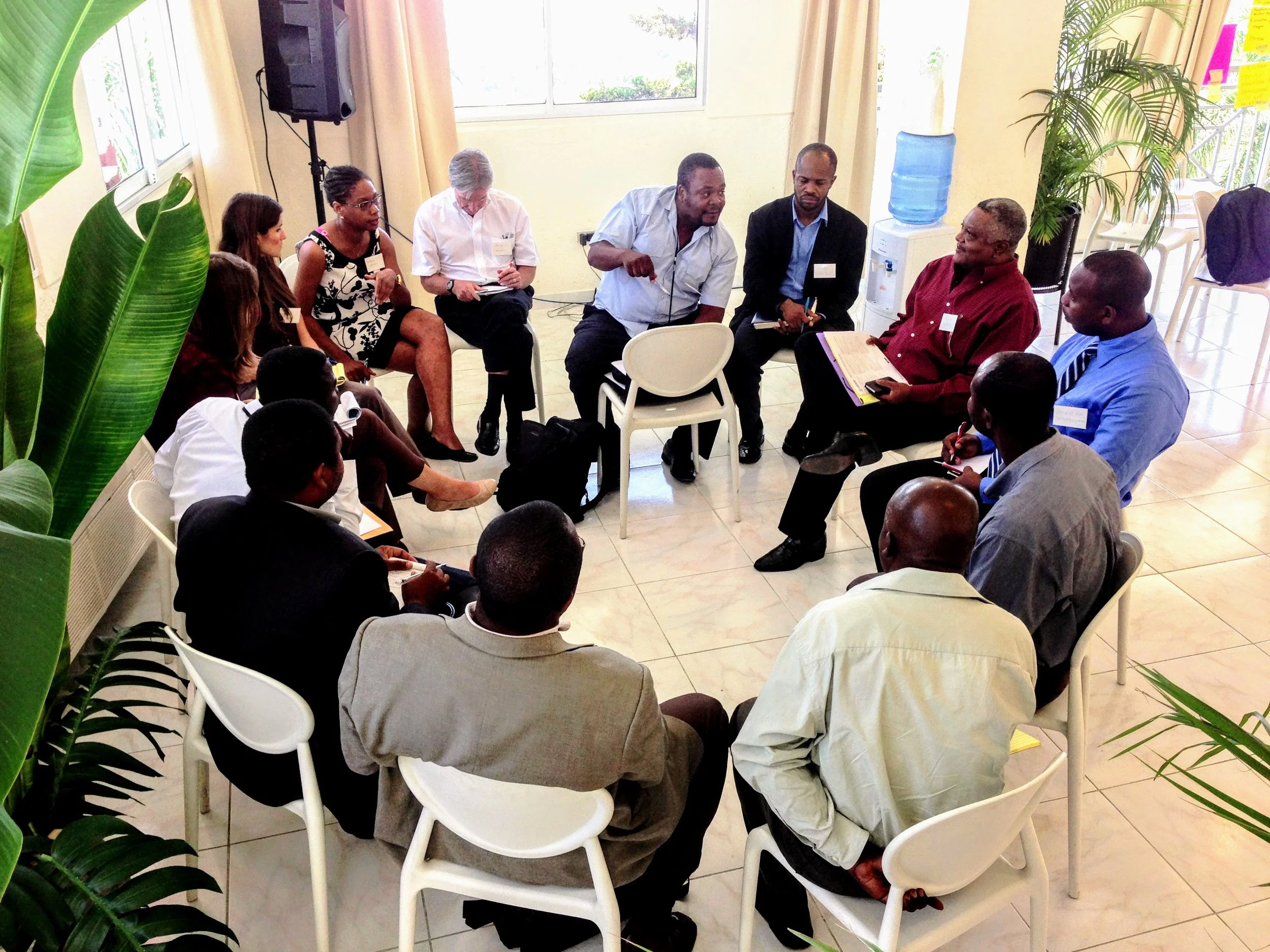
One of several breakout sessions of cooperative leaders during an Open Space meeting at Hotel Montanna, Port-au-Prince, Haiti 2013
It was 9:30 a.m. on Thursday, September 26, 2013. About sixty of us were seated in a circle in a conference room at the Hotel Montana complex in Port-au-Prince. It was one of the conference rooms built after the main hotel was destroyed in Haiti’s 2010 earthquake. Most were Haitian men, though a number of women were present as well.
The setting carried its own symbolism. Long associated with power and exclusivity, the Hotel Montana was now hosting a gathering designed to be open, participatory, and shared.
I had carefully prepared the room following Open Space practice. Large sheets of paper were posted on the walls, handwritten in Haitian Creole. They held the simple, demanding principles that guide this kind of work:
Whoever comes are the right people.
Whenever it starts is the right time.
Whatever happens is the only thing that could have happened.
When it’s over, it’s over.
Nearby were reminders of the Law of Two Feet, also known as the Law of Mobility, along with the phrase Passion bound by Responsibility. I had drawn, by hand, the image Open Space facilitators use to illustrate it: a butterfly and a bumblebee. Both move freely, guided by energy and purpose, neither obligated to remain where learning or contribution has ceased.
The circle itself was intentional. No podium. No hierarchy. No expert at the front of the room. Just people seated together, carrying experience, frustration, hope, and responsibility. Leaders of cooperatives from across Haiti had gathered to speak openly about their work and to learn from one another.
When it was time to begin, I handed the microphone to Saint Fort Dadaille, the representative of the Haitian government agency responsible for cooperatives. Poised and elderly, dressed in a suit, he walked into the center of the circle, looked slowly around the room, and paused.
“We are grateful that you have all come from around the country for this important gathering,” he began, speaking in Haitian Creole.
He explained that the day would be spent discussing the progress and challenges facing cooperatives in Haiti. Participants would propose topics themselves. Small groups would form. Notes would be taken and shared as part of a participatory evaluation.
Then he paused again.
“I want to begin with words that have been my mantra for decades,” he said. “We are condemned to cooperate.”
Nou kondane pou kowòpere.
He let the phrase hang in the air.
“With Haiti’s many challenges,” he continued, “we do not have a choice. If we wish to advance ourselves, we cannot work in isolation.”
He spoke of Haiti’s geography. Its history of brutality and exclusion. Environmental degradation, discrimination, and the barriers created by language and law. And then he returned to his central point.
“With all of this,” he said, “we do not have a choice.”
“We are condemned to cooperate.”
This was one of hundreds of Open Space meetings I facilitated over several decades in Haiti. As the day unfolded, participants proposed topics they felt mattered most, self-organized into small groups, and reported back with clarity and conviction.
As I write these words now, Haiti’s situation has grown increasingly precarious. The country faces a convergence of internal and external threats, and the future is deeply uncertain.
Yet while Haiti’s circumstances are unique, I have come to believe they also reflect something broader.
Haiti is not only a nation in crisis.
It is a mirror.
It reflects a world facing environmental collapse, political fragmentation, widening inequality, and a growing inability—or unwillingness—to cooperate across difference. Humanity, too, stands at a crossroads.
The statement is serious, even sobering.
And yet, if Haiti has taught me anything, it is this: collective work is often accompanied by joy. By laughter. By relationship.
Cooperation is not only a burden we must carry. It can also be a way of being human together.
Still, the truth remains as clear now as it was that day in Port-au-Prince.
We do not have a choice.
We are condemned to cooperate.
And that is why our moment is now.
What Now?
A Near-Death Moment and the Question That Refused to Let Go
“Grace is not a substitute for responsibility.”
— Dorothy Day
It was a normal Friday until it wasn’t.
It was Friday, October 14, 2016, at about 12:30 p.m. My coworker Reginald was driving our four-wheel-drive Nissan Patrol truck, and I was talking on my cell phone. Fridays are always busy at that hour in Haiti. School lets out early, and the streets quickly fill with students, parents, vendors, motorcycles, and traffic pushing in every direction at once.
We were driving through Pétion-Ville, a suburb of Port-au-Prince. I was distracted, absorbed in the conversation, paying little attention to what was happening outside the passenger-side window.
We slowed at a crowded intersection. Then the truck jerked. The clutch was released too quickly, causing the engine to stall.
I remember thinking, What did Reginald just do?
Before the thought finished forming, he yelled, “Bese tèt ou!” (head down) and dropped down as low as he could. Instinctively, I pulled the phone away from my ear and turned toward the window.
A gun was pointed at my face, inches away.
I ducked.
The shots came immediately.
The glass exploded. The sound was sharp and concussive, louder than I could fully register in the moment. Bullets tore through the windshield and the passenger-side window, fired from more than one direction. Another man stood in front of the truck, slightly to the left, shooting toward the driver’s side. I caught a glimpse of him in the split second I was going down.
Our windows were tinted, common in Haiti for security reasons, and required special permission. A vehicle with tinted windows is often assumed to carry armed occupants, which likely explains why they fired so many rounds so quickly. If they hesitated, if they waited to see who was inside, they might be shot first. Their assumption was incorrect. No guns in our truck.
Earlier that day, I had been at the bank. This attack was a consequence.
After what felt like seven or eight shots, the gunfire stopped. An eerie stillness followed. My head was pressed down near the emergency brake, my body instinctively trying to disappear. That’s when I noticed blood dripping onto the console.
I asked Reginald, “ Ou pran bal ? ” Were you hit?
“Non.” Thank God he wasn’t.
It didn’t make sense. I didn’t feel pain. Why was I bleeding? I wondered if I was in shock. I stayed low, waiting, unsure what would happen next.
Then the passenger door opened.
A man stood over me, gun pointed directly at my face, shouting in Haitian Creole, “Ban m sak la ! Get manman ou!” Give me the sack! F**k you! His voice was thick with rage.
I thought about the bag. Inside was the thousand dollars I had just withdrawn to pay an Argentinian man who had spent a month training our team to make handmade paper from natural fibers. My passport. My laptop. My work documents. Receipts. Years of effort and identity compressed into one bag.
I remember thinking, I don’t want to give this up. Surely someone would intervene. The police. The UN. Another armed person. Surely this would end quickly.
Then another thought cut through the noise. Over the years, I had heard too many stories of people who were robbed and killed because they refused to give what was demanded.
You stupid idiot, I told myself. Give him the bag.
I pushed it out the door. The sound of my laptop hitting the asphalt made my stomach tighten. They grabbed the bag, jumped on their motorcycles, and sped away.
Slowly, cautiously, Reginald and I lifted our heads. The danger had passed. The world seemed frozen. People stood in every direction, staring. No one moved.
I stepped out of the car. My face was covered in blood. A bullet hadn’t struck me, but it had shattered the glass, sending fragments into my face and leaving shallow wounds that bled freely.
People watched in silence. No one rushed forward. Perhaps they were afraid. Perhaps they thought I had done something to deserve this. In Haiti, public violence is often assumed to have a personal backstory. Whatever they believed, they stood still.
Then a well-dressed, fit man, perhaps in his mid-forties, ran into the intersection.
“Come with me,” he said. “Let’s get the car off the street.”
He moved with calm authority. Once the vehicle was safely parked, he took us into his office directly across the intersection. His staff brought hot tea, a customary response in Haiti after something traumatic. They brought towels and washcloths and gently cleaned the blood from my face.
They called the police. The UN. The embassy. These people we didn’t know stepped in with loving care. The grace that just spared our lives was still with us.
As I sat there, another man entered the office slowly and looked at me for a long moment before sitting down.
“I watched everything from my office window,” he said. “I saw the gunmen fire multiple times at head level into your truck. I was sure whoever was inside was dead. Then I saw one of them open the passenger door with his gun raised, and I thought, If anyone is still alive, they are about to be killed.”
He paused.
“I can’t believe you’re sitting here,” he said. “It wasn’t your time. You have work to do.”
The businessman’s name was Patrice. We were in capable hands. He arranged to have our truck secured on his property and offered to drive us wherever we needed to go. He told me his vehicle was bulletproof and that I had nothing to worry about.
I told him I needed to pick up my two young children from school.
We returned to the busy streets, moving slowly among pedestrians, motorcycles, and cars. The school was only a short distance away. When we arrived, a staff member walked my children through the gate and helped them into the vehicle.
They were confused. Why were we in someone else’s SUV? Who was this man driving? Why did their father have cuts all over his face? They could sense that something frightening had happened.
I hugged them and tried to reassure them, explaining that something unexpected and scary had occurred, but that we were safe and everything was going to be all right.
We drove up the mountain toward home. Patrice pulled into the driveway of our home and guesthouse and walked with us up the steps to the front patio, where Merline met us. She immediately knew something was wrong.
We hugged. I shared what I could. We cried.
Patrice embraced us and told us to let him know if we needed anything. I will never forget how he came to our rescue at a moment when Reginald and I were so vulnerable.
That afternoon, holding my children and watching Merline’s tears, I felt an overwhelming gratitude I didn’t know how to contain. We cried because we were alive, because we had almost not been, and because the world around us carried wounds that rarely make headlines. I prayed for Reginald and me. I prayed for Patrice and his brother, Allen. I prayed for the men who fired into our truck, not to excuse what they had done, but because something in me could not stop seeing their humanity beneath the violence.
As the hours passed, the shock softened into something quieter. Relief settled in. I was still here. I would sit at my table again. I would hold my children again. And alongside that relief was a collective sorrow, because none of what had happened belonged to me alone. Patrice carried the memory of his wife’s kidnapping. My family had brushed up against a grief that almost became permanent. And somewhere not far away were two young men whose lives had likely been shaped by a hardship I can barely imagine.
Poverty is violent. It wounds the human spirit until violence begins to feel like a language.
As the day came to a close and the ordinary tried to return, I didn’t feel driven to explain what had happened or why I had been spared. I felt called to pay attention. A question remained, steady as a shadow, following me home and refusing to disappear:
What now?
Choose Life

A Near Ending That Became a Beginning
“Tell me, what is it you plan to do with your one wild and precious life?”
— Mary Oliver
Wooosh.
A bottle tore through the air inches from my face, missile-fast, then shattered somewhere behind me. A pickup truck roared past, three young men laughing, their empty bottle turned into a joke at a hitchhiker’s expense. They didn’t slow down. They didn’t look back. They disappeared into the Alaskan dusk.
I stood frozen on the shoulder of a two-lane highway in the middle of nowhere. It was August 1983. I was nineteen years old, six thousand miles into a hitchhiking journey that had begun in Hershey, Pennsylvania, wound through Los Angeles, and was now carrying me north toward Fairbanks.
The fear spiked and then drained just as quickly. I wasn’t hurt. I wasn’t in danger anymore. But the adrenaline lingered, buzzing through my body, reminding me how close I’d come to not standing there at all.
I decided not to go any further that night.
The air was cool but gentle. Mountains rose in quiet silhouettes all around me. I walked a good distance from the road while there was still light, found a flat patch of ground, and rolled out my tarp and sleeping bag. No tent. I felt safe enough. I opened a tin of sardines with a bent spoon and ate slowly, staring up at the sky, replaying the moment.
Two inches the other way, I thought. Two inches, and none of this would exist for me.
Lying back in my sleeping bag, I watched darkness arrive late, the northern sky filling with stars brighter than any I’d known. I tried to imagine how long their light had traveled to reach my eyes, whether some of those stars even still existed. A speck on Earth. Earth, a speck in the universe. And somehow, here I was.
Why am I here?
Not in Alaska. On Earth.
Does life have meaning?
If so, what is mine?
This journey had made me acutely vulnerable. Nearly every day, sometimes for hours, I stood with my thumb out, trusting strangers to stop. At night, I slept under open skies, guessing where safety might be found. I’d left home with about three hundred dollars, no credit card, no phone. Why did the image of mountains inspire this kind of boldness? Why did movement feel necessary? What was I running from—or toward?
As I lay there, still shaken, another memory surfaced.
A year earlier, under a different starry sky, I had sat on a grassy hillside in Lancaster County, Pennsylvania, listening to Tony Campolo speak to thousands of people gathered for an outdoor Christian festival. His booming voice carried humor and urgency in equal measure. At one point, he described a sociological study—at least, that’s how I remember it—in which people over ninety-five were asked what they would do differently if they could live their lives again.
Their answers, he said, fell into three themes.
They would have taken more time to reflect, to live consciously, appreciating their relationships with others and other treasures in their lives.
They would have taken more risks in pursuit of their dreams.
They would have invested more in building something that would outlive them and improve the lives of others.
I never read the study. I don’t know if it even existed. It didn’t matter. Those three regrets lodged themselves somewhere deep inside me. They followed me now, lying under the Alaskan sky, humming beneath the questions I couldn’t shake.
And then my thoughts drifted to something closer. Much closer.
Five weeks earlier.
I was lying on the concrete floor of my father’s garage. The car was running. The garage door was closed.
I wasn’t crying. I wasn’t panicking. I wasn’t angry. I was exhausted. Hollowed out by a weight I didn’t know how to name.
That weight had been building for years.
My grandfather—whom we all adored—had died suddenly of a heart attack when I was twelve, just as my parents’ marriage began to fracture in ways that would stretch on for years. My mother eventually moved in with her own mother, taking my three younger siblings with her. My older sister had already left home at fifteen, after years of conflict that were heart-wrenching for all of us. I stayed with my father. What had once been a noisy, imperfect, loving family became something divided and unstable, held together by obligation and strained communication.
I didn’t know what to do with the sadness, the anger, or the confusion. So I learned how to numb it.
From ninth grade on, drugs and alcohol became a way to manage pain I didn’t yet have language for. There were multiple brushes with the law—underage drinking, selling marijuana, repeated meetings with police and detectives. I kept working. I kept showing up. I kept functioning. And I kept getting lucky.
Had I been Black, or poor, or unknown to the authorities, I would certainly have been sent to a juvenile detention center. Instead, I was given chance after chance. I was protected by privilege I hadn’t earned and didn’t yet fully understand.
By the time I was seventeen and eighteen, I had settled into a strange balance. I had friends I loved, I held down two steady jobs at a time, and detailed cars on the side. I stayed out of trouble. I was in a serious relationship that was both grounding and volatile. I rode my 1966 Harley-Davidson Electra Glide across the country twice. Motion helped. Work helped. Distraction helped. None of it healed what was underneath.
When that relationship finally ended, one of the last things holding things together gave way.
I knew, intellectually, that I was fortunate. I knew others had it far worse. But emotionally, I felt empty. I couldn’t see a future worth moving toward. The pain felt endless, and I wanted it to stop.
I had a plan.
As the garage filled with exhaust and the air grew heavy, something unexpected happened. A sudden, vivid image broke through the fog: mountains. Vast, majestic, soul-stirring mountains like the ones I’d seen as a boy on a family trip out west, and again as a teenager crossing the country on my motorcycle.
The image grabbed me.
Go. Go see them.
It wasn’t a voice, exactly. More like a knowing. I had a couple hundred dollars. I knew how to travel cheaply. I had friends in Colorado who would take me in. A future—however uncertain—snapped back into view.
That moment—call it grace, instinct, or sheer stubborn will—saved me.
Within days, I was on the road. Rides came easily. Colorado in two days. California, not long after. In a friend’s place, I saw a poster of Mount Denali and felt the pull again. Alaska. Now. I packed my bag and stuck out my thumb.
Somewhere in Canada, a man picked me up and ended up driving with me for over a thousand miles. Along the way, we stopped at a commune delivering supplies. Families lived there together with their children, bound by shared responsibility and purpose, helping one another survive harsh winters. It struck me how much strength came from belonging, from choosing community over isolation.
Now, lying under the Alaskan sky, I realized I was living inside the very vision that had pulled me back from the edge.
And then the sky began to move.
Green and violet waves rippled across the darkness, dancing above the mountains. The aurora borealis. I sat up in my sleeping bag, stunned. The bottle. The truck. The near miss. All of it fell away. This light—this impossible beauty—was mine to witness.
I felt peace. Wonder. A quiet sense of power. Purpose, not yet defined, but unmistakably present.
There’s a reason I’m still here, I thought.
The world holds immense suffering. Cruelty. Injustice. Grief that breaks people open and leaves them searching for ways to numb the pain. I knew that intimately. But it also holds beauty. Healing. Possibility. That night, under moving light and ancient stars, I began to understand something demanding and straightforward:
We all carry power.
The question is whether we’ll pay attention when life asks us what we’re going to do with it.
Pay Attention
An excerpt from a book in progress, Our Moment Is Now
I grew up in Hershey, Pennsylvania, a place so safe and orderly it sometimes felt shrink-wrapped. People called it The Sweetest Place on Earth, and in many ways, it lived up to the name. Streets were clean. Schools were well-resourced. Hospitals were modern and bright. Most families lived somewhere between modest and comfortable. Needs were met. Childhood unfolded predictably.
And yet, even there, something didn’t sit right.
No one I knew had guards, walls, or locks beyond the ordinary.
If there was deep poverty, it stayed mostly out of sight. Still, I caught glimpses. A few classmates came to school in dirty clothes, carrying an odor that marked them before they spoke. I remember how other kids teased them. I remember how that made my stomach tighten. I didn’t yet have language for injustice, but I felt its presence. Something was off. Something wasn’t fair.
Just twenty minutes away, in Harrisburg, I sometimes saw people sleeping on sidewalks. That troubled me deeply. I couldn’t understand how life could be so easy for some and so unforgiving for others. That confusion didn’t go away. It settled in quietly, like a question waiting for words.
My parents married young. My mother was still in high school when she became pregnant with my sister. They were in love and did what people then called “the proper thing.” They married, worked hard, and started a family that eventually grew to five children. I was number two.
Both of them had been raised in steady, church-going homes. They weren’t perfect, but they believed in showing up. In helping out. In making room. That belief shaped our household more than any rule ever could.
Our small hobby farm outside of Hershey became a kind of waystation. Sometimes people who were down on their luck stayed with us for a while. Friends came and went. So did animals. We had a goat, a burro, barn cats, 50 chickens, dogs, sheep, and sometimes ducks, as well as a half dozen cows. Plus, and a big garden that demanded attention whether we felt like giving it or not. On summer nights, the smell of cut grass and manure drifted through open windows, and kids from the neighborhood convened at our house for games like kick-the-can.
I still love watching the old home movies my grandfather filmed. He captured birthday cakes and picnics, church volleyball games, and potlucks. My parents appear young and vibrant, teasing each other while hanging laundry or loading the station wagon. Teenagers from church are everywhere, spilling into our house on Sunday evenings for youth group. Our home was over 120 years old, and my parents were gradually improving it, little by little. My dad would often joke about them killing 42 mice in traps the first night they slept in it. My sister Jodie and I were two and four years old when we first moved there. Jaynee, Jesse, and Justin came in the next five years. It was a two-story with small bedrooms. Downstairs normally felt full. Lots of activity. It was alive.
Looking back, I’m struck by how much generosity lived there despite limited means. We were living pretty close to paycheck to paycheck, but compassion seemed to be my parents’ default setting.
One of our regular family outings took us to a place most families avoided. On Sundays, we visited a halfway house for men recently released from prison. My parents called it “visiting friends.” We sat together, shared food, and listened to stories. As a child, I didn’t think of the men there as criminals. They were people who had made mistakes and were trying to begin again. They joked together and treated us like we mattered. They enjoyed entertaining us kids and making us laugh.
Those visits left an imprint. They taught me early that dignity isn’t earned; it’s extended. Or withheld. And that choice says more about the one who withholds it than the one who receives it.
When I was ten, our family opened its door again, this time to two strangers from the other side of the world. Chinh was twenty-three. His sister, Nhu, was twenty years old. They were Vietnamese refugees, survivors of a war that had dominated the news throughout my childhood.
I remember their arrival clearly. The hesitant smiles. Their several possessions in a plastic bag. They left their country with nothing. The unfamiliar aromas when they cooked. The government had asked families and churches, and other groups to sponsor refugees. My parents didn’t hesitate.
Chinh and Nhu became part of our household. We ate, worked, and played together. Through them, suffering ceased to be abstract. They told stories of poverty, loss, and terror. Of fleeing by boat. Of leaving family behind. I couldn’t fully grasp what they had endured, but I felt the weight of it. Their presence widened my world.
Those months and then years changed me. They planted seeds of empathy and responsibility that would continue to grow long after they moved on. Even then, I sensed something important: comfort carries obligation. Privilege isn’t a prize. It’s a call.
Faith ran quietly through all of this. We prayed before meals and before bed, but prayer also filled the spaces between. I learned to talk to God the way I talked to a friend. Thanking. Questioning. Sometimes arguing. That sense of companionship, of being accompanied even in uncertainty, has stayed with me ever since. But the mystery of it has grown even as a steady faith remains.
Hershey gave me security. But it was the contrast between sweetness and suffering that gave me direction. I didn’t yet know what to do with what I was seeing. I only knew I couldn’t unsee it.
Those early years taught me something essential, even if I couldn’t have put it into words at the time: before you can change anything, you have to pay attention. To people. To systems. To the quiet ways dignity is affirmed or denied. To the stories that don’t make headlines but shape lives all the same.
I carried those lessons forward without realizing it. They traveled with me into my teenage years and beyond, showing up as restlessness, curiosity, and a growing hunger for meaning. I didn’t yet have answers. I only had questions, and a sense that life was asking more of me than comfort alone could provide.
I was learning to pay attention.
Be Useful
An Invitation to a Larger WHY
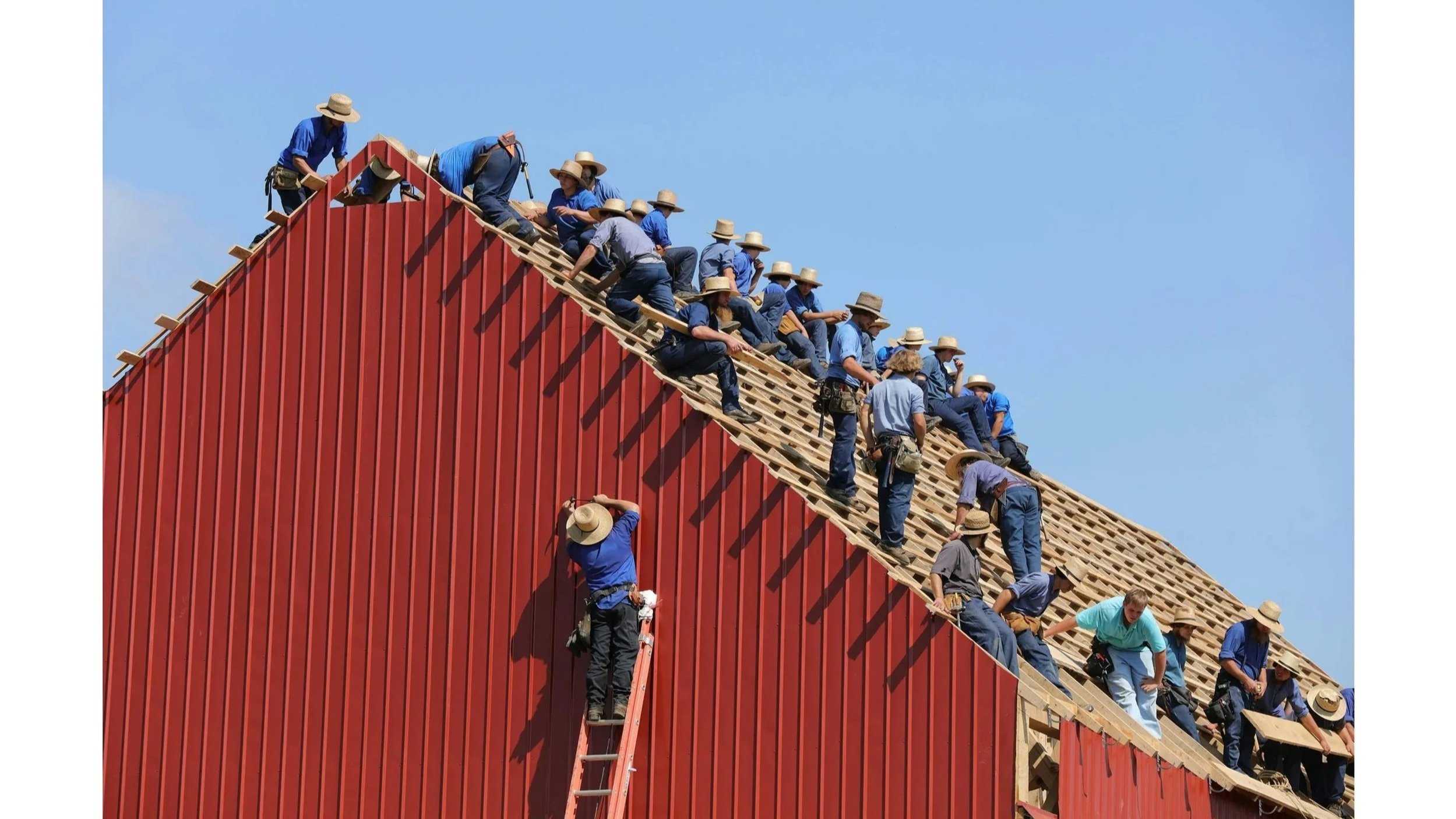
A barn-raising in Lancaster County
A reflection on how the simple idea of “being useful” has influenced my life, my work in Haiti, and a growing invitation to serve in new ways
There’s a simple phrase that has stayed with me for decades, long before I ever saw it on the cover of a book:
Be useful.
When Arnold Schwarzenegger chose those words as the title of his latest book, and I heard him describe what he meant by them, it immediately resonated. Not because the idea was new to me, but because it echoed something I had been learning my whole life—that real fulfillment and success don’t come from self-absorption or personal optimization, but from moving beyond self-interest toward contribution and service.
I first encountered Arnold long before I understood any of that.
I was twelve years old when I started lifting weights and buying muscle magazines. My father encouraged it, but never pushed it. He helped me buy a weight set from Reading Barbell, contributing to the money I had saved. He also encouraged me to play sports, which became a meaningful part of my life for many years.
My father’s own upbringing shaped his perspective. Raised in Lancaster County by parents influenced by the Mennonite tradition, sports were viewed by his father as a form of entertainment—and therefore not something to pursue.
My dad went against the grain and played football in high school anyway, even though his father never came to the games.
While my father departed from that upbringing in many ways, some values remained firmly intact: hard work around the house, gardening, maintaining a small farm, building things, digging, putting up fences. I don’t remember him ever joining a gym. Physical labor wasn’t something to outsource if you were able to do it yourself. It was the most practical way to stay strong.
That ethic stayed with me.
I’ve only joined a fitness club a couple of times in my life, and each time was short-lived. Not out of opposition, but preference. I’ve usually opted for long-distance running (before my knees wouldn’t tolerate it), as well as calisthenics and some weights at home. I strive to embrace hard work when it comes to house maintenance and lawn/property work. Cleaning, I’ve discovered, is an excellent way to burn calories. Even today, my wife Merline and I do our own cleaning at our Airbnb as well as our home. As my kids will tell you, I take particular satisfaction in hand cleaning our ceramic tile floors. It’s my form of yoga.
Over the years, I’ve also been shaped by people who embodied usefulness in far deeper ways.
I recall once asking Dr. Rodrigue Mortel, a distinguished Haitian-American physician whom we deeply loved and admired, whether he had ever played golf. He looked at me as if the question itself missed the point.
“I don’t have time for that,” he said.
Dr. Mortel, a member of the prestigious Horatio Alger Association, devoted his life not only to medicine but also to creating educational opportunities in Haiti. His legacy wasn’t leisure. It was impact—an impact his wife and daughters continue today with creativity and determination.
For the past thirty-five years, I’ve experienced profound meaning and fulfillment devoting my life to the mission of helping Haitians change Haiti through education. It has been a privilege to support Merline and the all-women leadership team at the Children’s Academy & Learning Center as they carry out demanding, courageous, and deeply fruitful work. The progress being made by the children, staff, and families—even amid unimaginable hardship—continues to humble me, as does the generous and faithful support of our donors.
Nine years ago, Merline and I moved back to the United States after I was robbed violently and nearly killed. Over time, and especially as the world has felt increasingly fragile, something began stirring in me. Not a desire to abandon my commitment to Haiti, but a sense that I was being invited to grow my WHY—to be useful in additional ways.
That stirring has led to a season of listening, searching, and gaining clarity about how I might serve beyond, and in conjunction with, my role as Co-Director of Haiti Partners. This website, johnengle.com, reflects that unfolding.
It’s not a declaration of arrival. It’s an invitation.
An invitation to reflect on purpose, legacy, and what it means to live—and eventually die—well. An invitation to explore how our lives can be oriented less around accumulation and more around contribution.
If any part of this resonates with you, I invite you to browse the site. And if it feels right, you’re welcome to book an exploratory conversation with me.
After all, we’re all still learning what it means to be useful.
P.S. In honor of Arnold’s reminder to be useful, I’m writing this with a cigar in hand. Even some Amish in Lancaster County enjoy tobacco. Discipline and enjoyment, it turns out, don’t have to be enemies. That said, no alcohol for me tonight—I’m participating in Dry January.