
Blog
Condemned to Cooperate
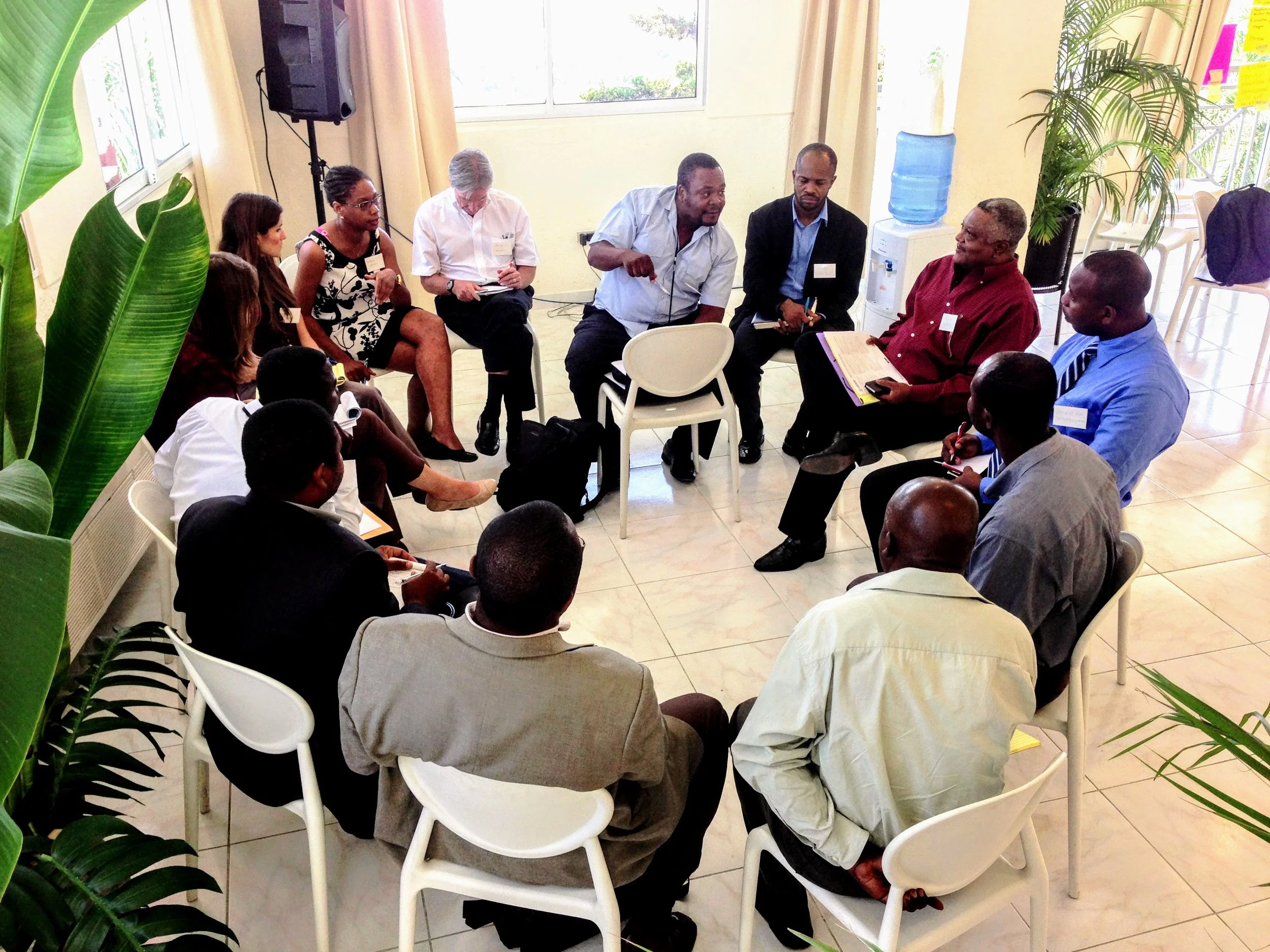
One of several breakout sessions of cooperative leaders during an Open Space meeting at Hotel Montanna, Port-au-Prince, Haiti 2013
It was 9:30 a.m. on Thursday, September 26, 2013. About sixty of us were seated in a circle in a conference room at the Hotel Montana complex in Port-au-Prince. It was one of the conference rooms built after the main hotel was destroyed in Haiti’s 2010 earthquake. Most were Haitian men, though a number of women were present as well.
The setting carried its own symbolism. Long associated with power and exclusivity, the Hotel Montana was now hosting a gathering designed to be open, participatory, and shared.
I had carefully prepared the room following Open Space practice. Large sheets of paper were posted on the walls, handwritten in Haitian Creole. They held the simple, demanding principles that guide this kind of work:
Whoever comes are the right people.
Whenever it starts is the right time.
Whatever happens is the only thing that could have happened.
When it’s over, it’s over.
Nearby were reminders of the Law of Two Feet, also known as the Law of Mobility, along with the phrase Passion bound by Responsibility. I had drawn, by hand, the image Open Space facilitators use to illustrate it: a butterfly and a bumblebee. Both move freely, guided by energy and purpose, neither obligated to remain where learning or contribution has ceased.
The circle itself was intentional. No podium. No hierarchy. No expert at the front of the room. Just people seated together, carrying experience, frustration, hope, and responsibility. Leaders of cooperatives from across Haiti had gathered to speak openly about their work and to learn from one another.
When it was time to begin, I handed the microphone to Saint Fort Dadaille, the representative of the Haitian government agency responsible for cooperatives. Poised and elderly, dressed in a suit, he walked into the center of the circle, looked slowly around the room, and paused.
“We are grateful that you have all come from around the country for this important gathering,” he began, speaking in Haitian Creole.
He explained that the day would be spent discussing the progress and challenges facing cooperatives in Haiti. Participants would propose topics themselves. Small groups would form. Notes would be taken and shared as part of a participatory evaluation.
Then he paused again.
“I want to begin with words that have been my mantra for decades,” he said. “We are condemned to cooperate.”
Nou kondane pou kowòpere.
He let the phrase hang in the air.
“With Haiti’s many challenges,” he continued, “we do not have a choice. If we wish to advance ourselves, we cannot work in isolation.”
He spoke of Haiti’s geography. Its history of brutality and exclusion. Environmental degradation, discrimination, and the barriers created by language and law. And then he returned to his central point.
“With all of this,” he said, “we do not have a choice.”
“We are condemned to cooperate.”
This was one of hundreds of Open Space meetings I facilitated over several decades in Haiti. As the day unfolded, participants proposed topics they felt mattered most, self-organized into small groups, and reported back with clarity and conviction.
As I write these words now, Haiti’s situation has grown increasingly precarious. The country faces a convergence of internal and external threats, and the future is deeply uncertain.
Yet while Haiti’s circumstances are unique, I have come to believe they also reflect something broader.
Haiti is not only a nation in crisis.
It is a mirror.
It reflects a world facing environmental collapse, political fragmentation, widening inequality, and a growing inability—or unwillingness—to cooperate across difference. Humanity, too, stands at a crossroads.
The statement is serious, even sobering.
And yet, if Haiti has taught me anything, it is this: collective work is often accompanied by joy. By laughter. By relationship.
Cooperation is not only a burden we must carry. It can also be a way of being human together.
Still, the truth remains as clear now as it was that day in Port-au-Prince.
We do not have a choice.
We are condemned to cooperate.
And that is why our moment is now.
Pay Attention
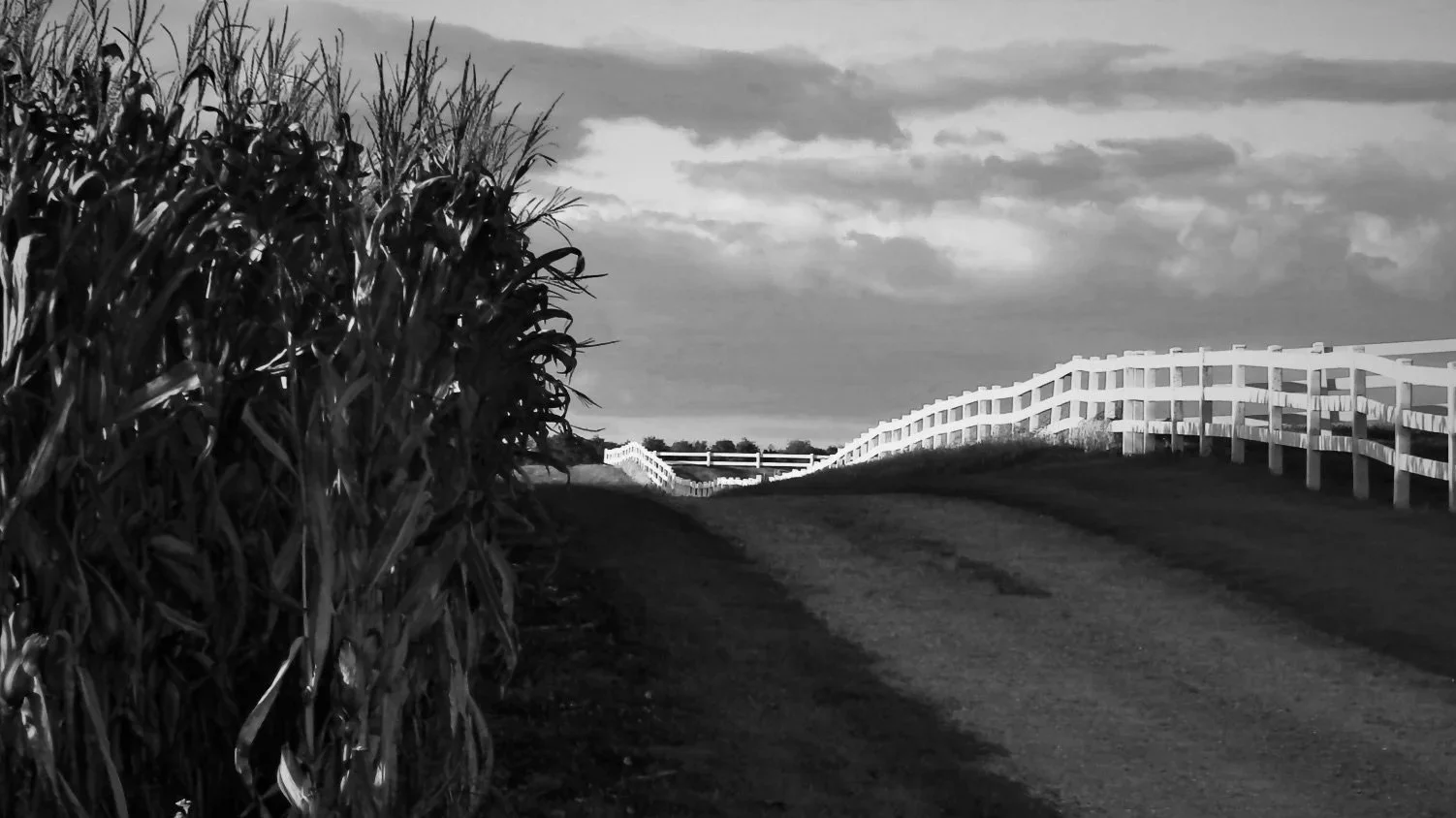
An excerpt from a book in progress, Our Moment Is Now
I grew up in Hershey, Pennsylvania, a place so safe and orderly it sometimes felt shrink-wrapped. People called it The Sweetest Place on Earth, and in many ways, it lived up to the name. Streets were clean. Schools were well-resourced. Hospitals were modern and bright. Most families lived somewhere between modest and comfortable. Needs were met. Childhood unfolded predictably.
And yet, even there, something didn’t sit right.
No one I knew had guards, walls, or locks beyond the ordinary.
If there was deep poverty, it stayed mostly out of sight. Still, I caught glimpses. A few classmates came to school in dirty clothes, carrying an odor that marked them before they spoke. I remember how other kids teased them. I remember how that made my stomach tighten. I didn’t yet have language for injustice, but I felt its presence. Something was off. Something wasn’t fair.
Just twenty minutes away, in Harrisburg, I sometimes saw people sleeping on sidewalks. That troubled me deeply. I couldn’t understand how life could be so easy for some and so unforgiving for others. That confusion didn’t go away. It settled in quietly, like a question waiting for words.
My parents married young. My mother was still in high school when she became pregnant with my sister. They were in love and did what people then called “the proper thing.” They married, worked hard, and started a family that eventually grew to five children. I was number two.
Both of them had been raised in steady, church-going homes. They weren’t perfect, but they believed in showing up. In helping out. In making room. That belief shaped our household more than any rule ever could.
Our small hobby farm outside of Hershey became a kind of waystation. Sometimes people who were down on their luck stayed with us for a while. Friends came and went. So did animals. We had a goat, a burro, barn cats, 50 chickens, dogs, sheep, and sometimes ducks, as well as a half dozen cows. Plus, and a big garden that demanded attention whether we felt like giving it or not. On summer nights, the smell of cut grass and manure drifted through open windows, and kids from the neighborhood convened at our house for games like kick-the-can.
I still love watching the old home movies my grandfather filmed. He captured birthday cakes and picnics, church volleyball games, and potlucks. My parents appear young and vibrant, teasing each other while hanging laundry or loading the station wagon. Teenagers from church are everywhere, spilling into our house on Sunday evenings for youth group. Our home was over 120 years old, and my parents were gradually improving it, little by little. My dad would often joke about them killing 42 mice in traps the first night they slept in it. My sister Jodie and I were two and four years old when we first moved there. Jaynee, Jesse, and Justin came in the next five years. It was a two-story with small bedrooms. Downstairs normally felt full. Lots of activity. It was alive.
Looking back, I’m struck by how much generosity lived there despite limited means. We were living pretty close to paycheck to paycheck, but compassion seemed to be my parents’ default setting.
One of our regular family outings took us to a place most families avoided. On Sundays, we visited a halfway house for men recently released from prison. My parents called it “visiting friends.” We sat together, shared food, and listened to stories. As a child, I didn’t think of the men there as criminals. They were people who had made mistakes and were trying to begin again. They joked together and treated us like we mattered. They enjoyed entertaining us kids and making us laugh.
Those visits left an imprint. They taught me early that dignity isn’t earned; it’s extended. Or withheld. And that choice says more about the one who withholds it than the one who receives it.
When I was ten, our family opened its door again, this time to two strangers from the other side of the world. Chinh was twenty-three. His sister, Nhu, was twenty years old. They were Vietnamese refugees, survivors of a war that had dominated the news throughout my childhood.
I remember their arrival clearly. The hesitant smiles. Their several possessions in a plastic bag. They left their country with nothing. The unfamiliar aromas when they cooked. The government had asked families and churches, and other groups to sponsor refugees. My parents didn’t hesitate.
Chinh and Nhu became part of our household. We ate, worked, and played together. Through them, suffering ceased to be abstract. They told stories of poverty, loss, and terror. Of fleeing by boat. Of leaving family behind. I couldn’t fully grasp what they had endured, but I felt the weight of it. Their presence widened my world.
Those months and then years changed me. They planted seeds of empathy and responsibility that would continue to grow long after they moved on. Even then, I sensed something important: comfort carries obligation. Privilege isn’t a prize. It’s a call.
Faith ran quietly through all of this. We prayed before meals and before bed, but prayer also filled the spaces between. I learned to talk to God the way I talked to a friend. Thanking. Questioning. Sometimes arguing. That sense of companionship, of being accompanied even in uncertainty, has stayed with me ever since. But the mystery of it has grown even as a steady faith remains.
Hershey gave me security. But it was the contrast between sweetness and suffering that gave me direction. I didn’t yet know what to do with what I was seeing. I only knew I couldn’t unsee it.
Those early years taught me something essential, even if I couldn’t have put it into words at the time: before you can change anything, you have to pay attention. To people. To systems. To the quiet ways dignity is affirmed or denied. To the stories that don’t make headlines but shape lives all the same.
I carried those lessons forward without realizing it. They traveled with me into my teenage years and beyond, showing up as restlessness, curiosity, and a growing hunger for meaning. I didn’t yet have answers. I only had questions, and a sense that life was asking more of me than comfort alone could provide.
I was learning to pay attention.
Be Useful
An Invitation to a Larger WHY
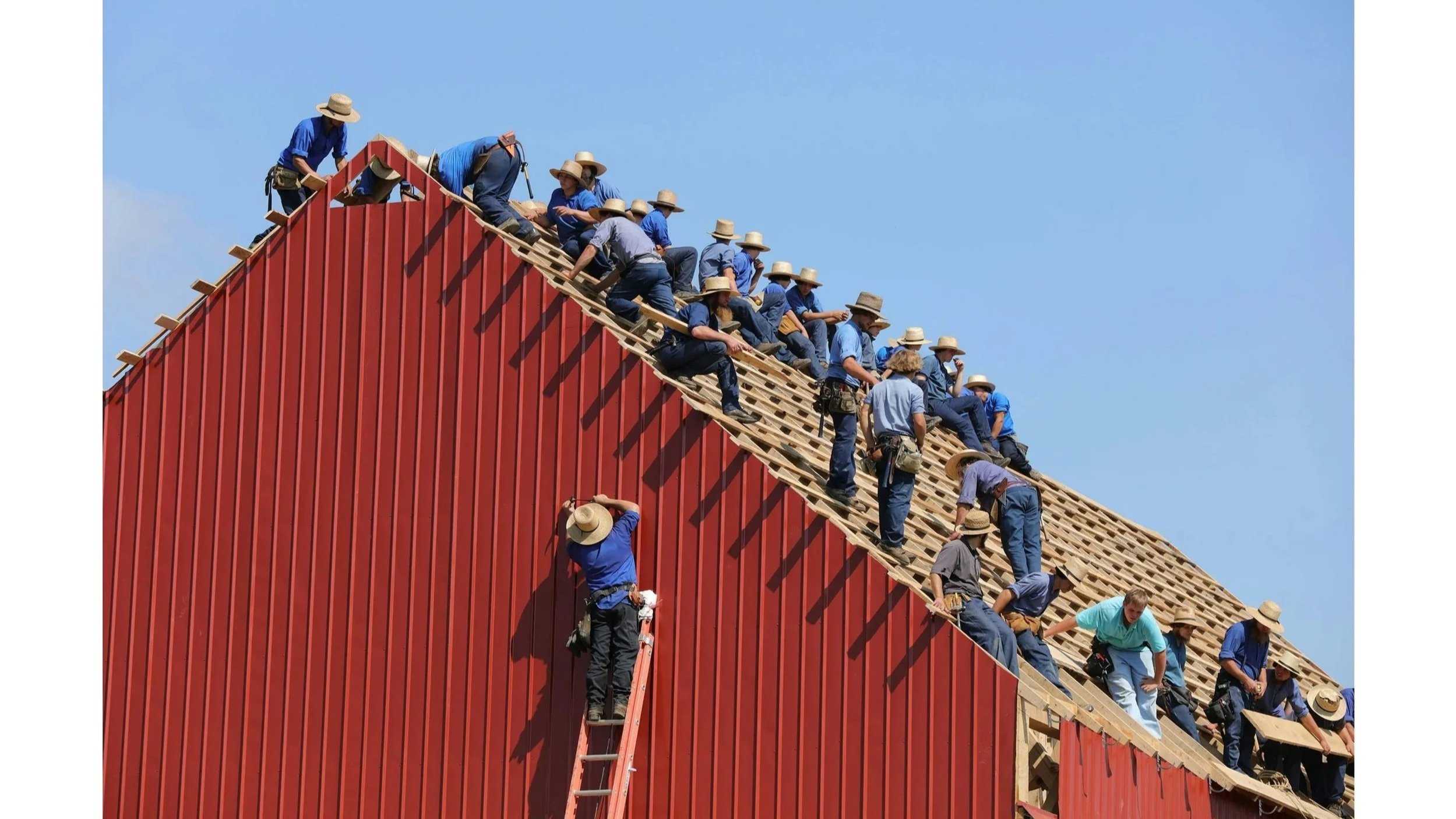
A barn-raising in Lancaster County
A reflection on how the simple idea of “being useful” has influenced my life, my work in Haiti, and a growing invitation to serve in new ways
There’s a simple phrase that has stayed with me for decades, long before I ever saw it on the cover of a book:
Be useful.
When Arnold Schwarzenegger chose those words as the title of his latest book, and I heard him describe what he meant by them, it immediately resonated. Not because the idea was new to me, but because it echoed something I had been learning my whole life—that real fulfillment and success don’t come from self-absorption or personal optimization, but from moving beyond self-interest toward contribution and service.
I first encountered Arnold long before I understood any of that.
I was twelve years old when I started lifting weights and buying muscle magazines. My father encouraged it, but never pushed it. He helped me buy a weight set from Reading Barbell, contributing to the money I had saved. He also encouraged me to play sports, which became a meaningful part of my life for many years.
My father’s own upbringing shaped his perspective. Raised in Lancaster County by parents influenced by the Mennonite tradition, sports were viewed by his father as a form of entertainment—and therefore not something to pursue.
My dad went against the grain and played football in high school anyway, even though his father never came to the games.
While my father departed from that upbringing in many ways, some values remained firmly intact: hard work around the house, gardening, maintaining a small farm, building things, digging, putting up fences. I don’t remember him ever joining a gym. Physical labor wasn’t something to outsource if you were able to do it yourself. It was the most practical way to stay strong.
That ethic stayed with me.
I’ve only joined a fitness club a couple of times in my life, and each time was short-lived. Not out of opposition, but preference. I’ve usually opted for long-distance running (before my knees wouldn’t tolerate it), as well as calisthenics and some weights at home. I strive to embrace hard work when it comes to house maintenance and lawn/property work. Cleaning, I’ve discovered, is an excellent way to burn calories. Even today, my wife Merline and I do our own cleaning at our Airbnb as well as our home. As my kids will tell you, I take particular satisfaction in hand cleaning our ceramic tile floors. It’s my form of yoga.
Over the years, I’ve also been shaped by people who embodied usefulness in far deeper ways.
I recall once asking Dr. Rodrigue Mortel, a distinguished Haitian-American physician whom we deeply loved and admired, whether he had ever played golf. He looked at me as if the question itself missed the point.
“I don’t have time for that,” he said.
Dr. Mortel, a member of the prestigious Horatio Alger Association, devoted his life not only to medicine but also to creating educational opportunities in Haiti. His legacy wasn’t leisure. It was impact—an impact his wife and daughters continue today with creativity and determination.
For the past thirty-five years, I’ve experienced profound meaning and fulfillment devoting my life to the mission of helping Haitians change Haiti through education. It has been a privilege to support Merline and the all-women leadership team at the Children’s Academy & Learning Center as they carry out demanding, courageous, and deeply fruitful work. The progress being made by the children, staff, and families—even amid unimaginable hardship—continues to humble me, as does the generous and faithful support of our donors.
Nine years ago, Merline and I moved back to the United States after I was robbed violently and nearly killed. Over time, and especially as the world has felt increasingly fragile, something began stirring in me. Not a desire to abandon my commitment to Haiti, but a sense that I was being invited to grow my WHY—to be useful in additional ways.
That stirring has led to a season of listening, searching, and gaining clarity about how I might serve beyond, and in conjunction with, my role as Co-Director of Haiti Partners. This website, johnengle.com, reflects that unfolding.
It’s not a declaration of arrival. It’s an invitation.
An invitation to reflect on purpose, legacy, and what it means to live—and eventually die—well. An invitation to explore how our lives can be oriented less around accumulation and more around contribution.
If any part of this resonates with you, I invite you to browse the site. And if it feels right, you’re welcome to book an exploratory conversation with me.
After all, we’re all still learning what it means to be useful.
P.S. In honor of Arnold’s reminder to be useful, I’m writing this with a cigar in hand. Even some Amish in Lancaster County enjoy tobacco. Discipline and enjoyment, it turns out, don’t have to be enemies. That said, no alcohol for me tonight—I’m participating in Dry January.